Daisy and Lewis Campbell both studied at Exeter University, Lewis did his PHD at University of Exeter CC and Daisy took her undergraduate degree and masters. It was during this time that Koru met Daisy on one of the Marine Biology’s annual University kayak adventures with Koru and she came to work with us during the season. A few years on and she’s now set up Trace Biomonitoring with Lewis which is an amazing operation that can detect the species in a small sample of water. They both joined us on a Koru Kayak Adventure on the North Coast from St Agnes last Autumn and on the South Coast on the Helford. Here’s what they found with Daisy’s guest blog below:
Daisy Campbell – Trace Biomonitoring
In the final sunny week of 2025, the team from Trace Biomonitoring teamed up with Tom and Hetty from Koru Kayaking to explore an exciting question:
Can we discover which organisms share the water with us, without ever seeing them?
The answer lies in a powerful technique called environmental DNA (eDNA). Every organism leaves tiny traces of genetic material behind in the water: skin cells, mucus, scales, waste, or microscopic fragments. By collecting and analysing water samples, scientists can read these genetic “breadcrumbs” and uncover the hidden biodiversity of an ecosystem – from microbes to marine mammals.
And what better place to try it than the spectacular coastline explored on Koru’s kayak adventures?
Taking advantage of Koru’s beautiful but contrasting routes, the team sampled both the north and south coasts of Cornwall.
On the north coast at St Agnes, dramatic cliffs plunge into the Atlantic. Kayaking through rock gardens and archways, surrounded by vibrant orange and green cliff faces, the team experienced the raw energy of the open ocean. Along the way they were lucky enough to spot seals, soon to be gearing up for the breeding season.

Photo: Trace Biomonitoring Comprehensive Biodiversity kits ready to take on Koru’s sunny yellow kayaks for a North Coast adventure.
Over on the south coast at Grebe/Durgan on the Helford River, the atmosphere couldn’t have been more different. Here the water is calm and sheltered, winding past ancient oak woodland and the rare Atlantic temperate rainforest that lines the banks. Mudflats, sandbanks, rocky shores, seagrass meadows and maerl beds create a patchwork of habitats that support an incredible diversity of life. This unique ecosystem is protected as a Special Area of Conservation (SAC).
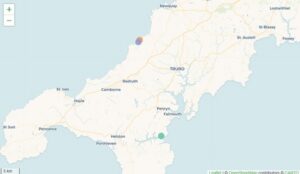
Photo: A sample map showing the three sites at St Agnes (North Coast Adventure) and the Helford (South Coast Adventure)
Two coastlines. Two completely different environments. One fascinating question: who lives here?
Collecting invisible clues
While paddling along the routes, the team collected water using a large syringe and pushed it through an extremely fine filter, collecting genetic material from the water. Tiny fragments containing DNA from organisms that inhabit or have recently passed through the area.

Photo: Co-owner of Koru Kayaking, Tom Wildblood, taking a water sample for the Comprehensive Biodiversity panel.
Back in the laboratory, scientists extracted the DNA from the filter and compared it against global genetic databases. Because every species has a unique genetic “signature,” it’s possible to identify who left their trace in the water.
What did we find?
From just a few surface water samples, the survey detected 924 unique organisms across the three sampling locations. Among them were 13 invasive species and 5 species of conservation concern, including: common dolphin, Eurasian oystercatcher, and golden grey mullet.
The results also revealed an extraordinary mix of marine life.
Off Durgan on the Helford, DNA traces revealed species such as: catsharks, crumb-of-bread sponge, eelgrass and mauve stinger jellyfish.

Photo: Mauve Stinger Jellyfish Pelagia noctiluca – from https://www.cornwallwildlifetrust.org.uk/wildlife-explorer/marine/jellyfish/mauve-stinger
Meanwhile, the north coast waters showed signs of: grey seals, common dolphins and corkwing wrasse.
And the most exciting part? These results came from small volumes of surface water, meaning that further sampling at a variety of depths, could reveal even greater biodiversity.
For the Trace Biomonitoring team – former residents and long-time lovers of West Cornwall – this project was a special one. Not only did it combine adventure with science, it also provided a first baseline snapshot of biodiversity along Koru’s kayaking routes using eDNA.
And who knows what we might detect next? Future surveys could even pick up the genetic traces of some of Cornwall’s most exciting visitors – basking sharks, sunfish, or even whales.
Curious to see what lies beneath? Read the full report here: https://trace-biomonitoring.shinyapps.io/edna_coastal_pilot/